11 Stock Investing Strategies That Actually Work in the Indian Market
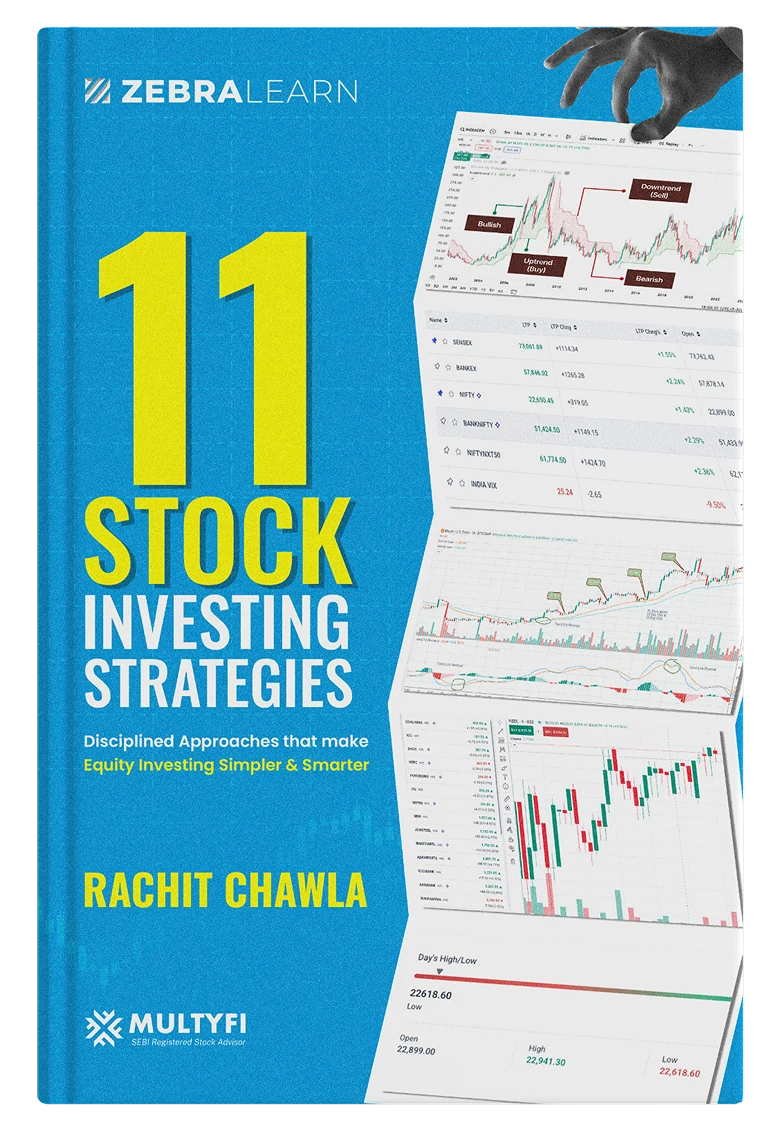
Most Indian investors buy stocks. Very few have a strategy. Even fewer beat the Nifty50 consistently. This book by Rachit Chawla gives you 11 proven, data-backed equity strategies — each benchmarked against the Nifty50 - so you know exactly what works, when it works, and why.
11 complete strategies: from Promoter Buying to Growth Investing
Each strategy benchmarked vs. Nifty50 with real performance data
Entry rules, exit rules, stop-loss logic — all clearly defined
India-first: NSE, Chartink, Supertrend, Sectoral Rotation & more
392 pages of pure investing intelligence — zero fluff.

Are You Investing in the Market — or Just Gambling in It?

India now has over 20 crore Demat accounts. Every month, lakhs of new investors open accounts, buy stocks, and wait for returns that mostly never come.The problem isn't the market. The problem is the absence of any structured strategy. Most retail investors buy on tips, panic-sell on corrections, and underperform a simple Nifty50 index fund every single year.
40
lost by retail investors in derivatives alone in a single year — the result of emotion over strategy.
73%
lost by retail investors in derivatives alone in a single year — the result of emotion over strategy.
95%
lost by retail investors in derivatives alone in a single year — the result of emotion over strategy.
1.1L Cr
lost by retail investors in derivatives alone in a single year — the result of emotion over strategy.
The hard truth About Retail Investing In India
You don't need more tips. You don't need more apps. You need a strategy — tested, benchmarked, and clearly explained. That is exactly what this book delivers.
That is exactly what this book delivers.
INDIA'S STOCK MARKET — THE NUMBERS TELL THE STORY

India Is One of the World's Fastest-Growing Equity Markets. Are You Positioned to Profit?

20 Cr+
Demat accounts in India as of 2025 — a 5x increase in just 5 years
319%
Growth in demat accounts from FY13 to FY24 — India's retail investor base is exploding
₹61L Cr+
Mutual fund AUM as of 2024 — up from Rs. 12 lakh crore in 2020
21,000 Cr+
Monthly SIP inflows in India — the country's investment culture has permanently shifted
54%
Average IPO listing gains in 2024 — far above global benchmarks
19%
India's weight in the MSCI Emerging Markets Index — up from 7% a decade ago

Two Types of Investors. One Book That Makes the Difference.

Before Reading This Book
Buying stocks based on Telegram channels and YouTube tips
No idea how to find entry points or set stop-losses
Panic-selling every time Nifty drops 3%
Watching momentum stocks run without understanding why
Losing money consistently while the index keeps going up
No framework for which sectors to be in — or when to rotate
Investing feels like guessing
After Applying These 11 Strategies
Using Promoter Buying signals to identify smart money moves
Reading momentum indicators (Supertrend + RSI) with confidence
Entering and exiting trades with pre-defined rules — no emotion
Identifying 52-Week High breakouts before institutional buying kicks in
Rotating sectors based on economic cycles, not headlines
Applying the Magic Formula to screen high-quality, undervalued stocks
Investing with the clarity and discipline of a professional

392 Pages. 11 Strategies.
Every One Benchmarked Against the Nifty50.

Most investing books give you theory. This one gives you a system.

Every chapter in 11 Stock Investing Strategies follows the same rigorous structure: explain the strategy, show how it works with real data, define the entry and exit rules, and then compare actual performance against the Nifty50 benchmark — so you can see the evidence before you commit a single rupee.
Before Reading This Book
From Promoter Buying and Momentum to Magic Formula and Contrarian Investing — one book covers them all.
Nifty50 Benchmarked
Every strategy is tested and compared against the Nifty50 index. You see what beats it — and by how much.
Entry + Exit Rules
Defined No vagueness. Each strategy tells you exactly when to buy, when to set your stop-loss, and when to exit.
India-Specific Tools
Chartink, NSE screener, Supertrend, RSI, Sectoral Indices — built for the Indian market, not adapted from Western books.
For All Experience Levels
Whether you just opened your Demat account or have been investing for years, the frameworks are clear and progressive.
Covers All Market Conditions
Momentum markets, sectoral rotations, corrections, sideways phases — there is a strategy for every market environment.

What You Will Learn — Chapter by Chapter

Click any chapter to explore what is covered inside.
Chapter 1: Introduction & Strategy 1 — Promoter Buying
What will you learn in this chapter?
Understanding the Stock Market — Page 16
Systematic Profits: An Approach for Outperforming Nifty50 Index — Page 17
The Role of Promoter Buying in Investment Decisions — Page 18
Step-by-Step Guide to Navigate NSE India — Page 24
Simple Criteria for Selecting Stocks — Page 32
How to Interpret Promoter Buying Trends? — Page 45
Setting Clear Investment Goals — Page 50
Next Steps in Your Investment Journey — Page 54
Chapter 2: Momentum-Based Buying through Indicators
What will you learn in this chapter?
Buying Through Indicators — Page 58
Momentum is Crucial in the Stock Market — Page 58
Stock Momentum Can Help Investors Generate Consistent High Returns — Page 59
Benefits of Making Momentum-Based Trading Decisions — Page 61
Supertrend Indicator — Page 66
How Does the Supertrend Indicator Work? — Page 68
Relative Strength Index (RSI) — Page 70
Combining Supertrend and RSI — Page 73
Rules to Follow to Create a Momentum-Based Strategy — Page 74
Benefits of Creating a Combined Trading Strategy — Page 75
Creating a Viable Momentum-Based Trading Strategy — Page 76
Identification of Stocks for Momentum Trading — Page 78
Comparing Momentum-Based Strategy with Nifty50 Benchmark — Page 80
So, What Did We Learn? — Page 82
Every Trading Strategy Requires Constant Learning and Action! — Page 84
Chapter 3: Sectoral Investing
What will you learn in this chapter?
Sectoral Investing — Page 88
What is Sector Rotation? — Page 88
Why Sector Rotation is Important? — Page 90
Comparing Sectoral Rotation Strategy with Nifty50 Benchmark — Page 95
Sector Rotation Reflects Economic Cycles — Page 96
Identifying Promising Sectors — Page 98
Key Indicators for Sector Performance — Page 99
Observing and Analysing Trends — Page 103
Practical Examples of Sector Analysis — Page 105
Tools and Resources for Sector Analysis — Page 110
Practical Example of Calculations — Page 116
Risk Management — Page 123
Why Risk Management is Crucial? — Page 123
Basic Concepts of Risk Management — Page 126
Techniques for Managing Risk — Page 130
Continue Learning and Practicing — Page 132
Chapter 4: 52-Week High and All-Time High
What will you learn in this chapter?
What Are 52-Week Highs and All-Time Highs? — Page 136
How Are These Highs Calculated? — Page 138
Importance of Highs in the Stock Market — Page 140
Momentum and Highs — Page 141
Websites That Can Be Used to Identify 52-Week and All-Time Highs — Page 144
Rules for Entry and Exit — Page 150
Setting Stop-Loss Orders — Page 153
Monitoring and Adjusting Your Portfolio — Page 154
Aligning Your Investments with Your Financial Objectives — Page 157
Chapter 5: Inside Bar
What will you learn in this chapter?
What Are Inside Bars? — Page 160
Basic Concepts You Need to Know to Understand Inside Bars — Page 162
How to Identify Inside Bars? — Page 166
The Market Can React to Inside Bars Post-Momentum in Two Ways — Page 169
Assessing Potential Breakouts Based on Inside Bars — Page 171
Steps to Create an Inside Bar Trading Strategy — Page 173
Combining Inside Bar with Other Indicators — Page 174
Risk Management — Page 174
Comparing Inside Bar Strategy with Nifty50 Benchmark — Page 177
Chapter 6: Market Leaders of the Past Quarter
What will you learn in this chapter?
Market Leaders of the Past Quarters — Page 182
Understanding Market Leaders — Page 182
Why Is the Identification of Market Leaders Important? — Page 184
The Actual Job at Hand: How to Identify Market Leaders? — Page 195
Defining Entry Points — Page 202
Setting Exit Points — Page 207
What Is Portfolio Churning? — Page 211
Strategies for Effective Churning — Page 216
Comparing Market Leaders Strategy to Nifty50 Benchmarks — Page 222
Chapter 7: Magic Formula
What will you learn in this chapter?
How and Why Does the Magic Formula Work? — Page 229
So, How Does the Magic Formula Narrow Down on Stocks? — Page 235
Understanding Return on Capital (ROC) — Page 240
Identifying Stocks with the Magic Formula — Page 242
Allocation and Diversification Strategies — Page 245
Monitoring and Adjusting Your Portfolio — Page 246
Comparing Magic Formula Strategy to Nifty50 Benchmark — Page 252
Conclusion — Page 253
Chapter 8: Dow Theory
What will you learn in this chapter?
The Six Tenets of Dow Theory — Page 258
How Dow Theory Comes in Handy in the Modern Stock Market? — Page 276
Strategy Rules — Page 278
Comparing Dow Theory Trading Strategy with Nifty50 Benchmark — Page 285
Conclusion — Page 287
So, What is Next? — Page 288
Chapter 9: Moving Average Crossover
What will you learn in this chapter?
What Are Moving Averages? — Page 292
Basic Concepts and Terminologies — Page 293
How Do Moving Averages Help Investors? — Page 295
How Moving Averages Smooth Out Price Data? — Page 296
Types of Moving Averages — Page 297
Entry and Exit Criteria — Page 305
Key Takeaways to Remember! — Page 311
Chapter 10: Contrarian Investing
What will you learn in this chapter?
Contrarian Investing — Page 314
Basic Concepts and Terminologies — Page 316
How Does Contrarian Investing Work? — Page 320
Historical Performance and Validation — Page 321
Core Principles of Contrarian Investing — Page 325
Market Conditions for Contrarian Investing — Page 335
A Step-by-Step Guide to Use Chartink for Contrarian Investing — Page 337
Entry and Exit Criteria — Page 346
Comparing Contrarian Investment Strategy with Nifty50 Benchmark — Page 353
Chapter 11: Growth Investing
What will you learn in this chapter?
Basic Concepts and Terminologies — Page 358
How Does Growth Investing Work? — Page 360
Historical Performance and Validation — Page 362
What Will Govern Our Decisions With Respect to Growth Investing? — Page 363
Defining Entry Points — Page 378
Setting Exit Points — Page 379
Staying Committed to Your Strategy — Page 382
Comparing Growth Investment Strategy with Nifty50 Benchmark — Page 384
Conclusion — Page 386

This Book Is the Right Fit If You Are One of These

The strategies in this book work for every type of investor — from someone who just opened a Demat account to someone who has been investing for a decade and still struggles to beat the index.
Salaried Professional
Salaried Employees & Working Professionals How It Helps: You do not have time to stare at screens all day. These strategies are designed to be systematic, rule-based, and applicable with just 1–2 hours a week — without quitting your job or watching every tick.
Business Owner
Business Owners & Entrepreneurs How It Helps: Your business generates income. This book shows you how to deploy surplus capital into a disciplined equity strategy — so your money works as hard as you do, independent of your business cycle.
Young Investor
Students & First-Time Investors (Age 18–28) How It Helps: Starting early is the biggest investing advantage you have. This book gives you a structured foundation — covering Promoter Buying, Momentum, and Sectoral Rotation — so you begin right, not wrong.
Homemaker
Homemakers & Family Financial Decision Makers How It Helps: You manage household finances better than most people manage portfolios. This book teaches you clear, rule-based strategies to grow family savings through the stock market with confidence and control.
Accounting Professional
Finance, CA, Banking & Accounting Professionals How It Helps: You understand numbers. This book bridges the gap between financial literacy and practical equity investing — with strategies like the Magic Formula and Contrarian Investing that align with your analytical thinking.
Experienced Investor
Investors Who Have Been in the Market 3–10 Years How It Helps: If you have been investing but still underperform the Nifty50, this book explains exactly why — and gives you 11 tested strategies to change that, with benchmarked evidence to back each one.
NOT FOR YOU IF:
This book is not for you if you are looking for intraday tips, F&O speculation strategies, or guaranteed return schemes. This is a book about disciplined, systematic, evidence-based long-term equity investing.

The 4 Most Common Reasons Indian Investors Underperform

& Which Chapter Fixes Each
89%
No Defined Entry
uying stocks with no defined entry criteria — waiting for "the right feeling"
THE FIX:
Chapter 1 (Promoter Buying) + Chapter 4 (52-Week High) — both chapters define exact, screener-based entry rules
76%
No stop-loss discipline
No stop-loss discipline — holding losing stocks hoping they will recover
THE FIX:
Chapter 5 (Inside Bar) + Chapter 8 (Dow Theory) — both teach structured stop-loss placement and exit logic
68%
Missing rotation
staying invested in the wrong sector at the wrong time
THE FIX:
Chapter 3 (Sectoral Investing) — covers how to identify which sectors lead in each phase of the economic cycle
71%
Chasing top
buying after the move has already happened
THE FIX:
Chapter 2 (Momentum Indicators) + Chapter 6 ( Leaders) — teach how to identify momentum , not late

What the Data Says About Systematic Investing

Promoter-heavy stocks have historically delivered 2–3x the index returns over 5-year periods on NSE
Momentum-based strategies consistently outperform the Nifty50 by 8–12% annually when applied with discipline
Sectoral rotation strategies that follow economic cycles have beaten buy-and-hold index investing in 7 of the last 10 years in India
Contrarian investors who buy undervalued out-of-favour stocks in India have generated average returns of 28–35% in recovery phases
READER REVIEWS

What Readers Across India Are Saying

Rajesh Shah, Business Owner, Surat
"I have a textile business and used to park all surplus in FDs. After reading about the Contrarian Investing strategy and the 52-Week High strategy, I started allocating a portion of surplus into equity systematically. The benchmarking against Nifty50 in each chapter is what convinced me this wasn't just theory."
Arjun Reddy, Marketing Executive, Hyderabad
"I am 26, been investing for 2 years, always underperforming. The Sectoral Investing chapter opened my eyes. I had no idea sector rotation could be tied to economic cycles so systematically. I restructured my portfolio around 2 strong sectors and saw better results within one quarter."
Priyanka Joshi, Chartered Accountant, Mumbai
"As a CA, I know how to read a balance sheet. But applying that to stock selection was always the missing piece. The Magic Formula chapter (Chapter 7) gave me an elegant, systematic way to rank stocks by Return on Capital and earnings yield. I now run this screen every quarter."
Sunita Mehta, Homemaker, Jaipur
"I am a homemaker and was always told the stock market is not for me. I picked up this book because the title seemed straightforward. I am now 3 months in, using the Promoter Buying strategy from Chapter 1 to filter stocks before I invest. I feel in control for the first time."
Rohit Agarwal, IT Professional, Pune
"Strategy 2 — the Supertrend + RSI combination — completely changed how I trade. I spent 2 years watching indicators I never understood. After Chapter 2, I had a system with clear buy and sell signals. I applied it the very next week. It works."
Vikram Nair, Senior Software Engineer, Bengaluru
"I have read at least a dozen investing books. This is the only one where every chapter ends with actual performance data compared to the Nifty50. That level of transparency gave me the confidence to actually apply what I read. My portfolio has outperformed the index for the first time in 4 years."
ABOUT THE AUTHOR
Rachit Chawla
Investor | Financial Educator |Author
Rachit Chawla is a seasoned investor and financial educator with deep expertise in Indian equity markets. As the author of 11 Stock Investing Strategies published in association with ZebraLearn and Multyfi he has distilled years of market experience into a framework that any investor can understand and immediately apply.

Rachit's approach is built on one core belief: that consistent returns come from systematic strategy, not instinct. Every strategy in this book has been designed with clearly defined entry rules, exit rules, risk management guidelines, and benchmarking against the Nifty50.
Author of a 392-page, strategy-first guide to Indian equity markets
Active investor with hands-on experience across multiple Indian market cycles
Every strategy benchmarked with real Nifty50 comparison data
Mission: Making disciplined, strategic investing accessible to everyone

Frequently Asked Questions

Q: Is this book suitable for someone who has never invested before?

When expanded: Yes. The book begins with Chapter 1 covering how to understand the stock market and navigate NSE India — making it fully accessible to first-time investors. Concepts are explained clearly before each strategy is introduced. You do not need any prior investing knowledge to begin.

Q: Are these strategies specific to the Indian stock market?

When expanded: Yes, entirely. All examples, tools (NSE screener, Chartink, Supertrend), sector references, and benchmarks are India-specific. Every strategy is compared against the Nifty50 index — not the S&P 500 or any foreign benchmark. This is not a translated Western investing book.

Q: Do I need a finance or commerce background to understand this book?

When expanded: No. The book is written in plain language. Financial terms are explained as they appear. The goal is to make professional-grade strategy accessible to everyone — whether you are an engineer, a teacher, a homemaker, or a business owner.

Q: How is this different from other investing books available in India?

When expanded: Most investing books cover general theory. This book gives you 11 distinct strategies — each with defined entry criteria, exit rules, stop-loss logic, and a comparison of actual returns against the Nifty50 benchmark. You can evaluate every strategy with real performance evidence before applying it.

Q: How long does delivery take for the hard copy?

When expanded: Standard delivery across India typically takes 5–7 business days. Cash on Delivery (COD) is available for most pin codes. You can also opt for the soft copy for instant access immediately after purchase.

Q: What is the difference between the hard copy and the soft copy?

When expanded: The content is identical in both editions. The soft copy is a digital file you can access on any device immediately after purchase. The hard copy is a printed book delivered to your address — preferred by many readers for annotation, highlighting, and extended reading sessions.

Q: Can I gift this book?

When expanded: The hard copy makes an excellent gift for anyone beginning or continuing their investing journey — students, working professionals, business owners, or family members who want to take control of their financial future.

LIMITED PERIOD OFFER