Hard copy
- Full 400+ page printed book
- All 14 chapters and frameworks
- Made to keep on your desk and mark up
Content as Capital, by Sooraj Divakaran
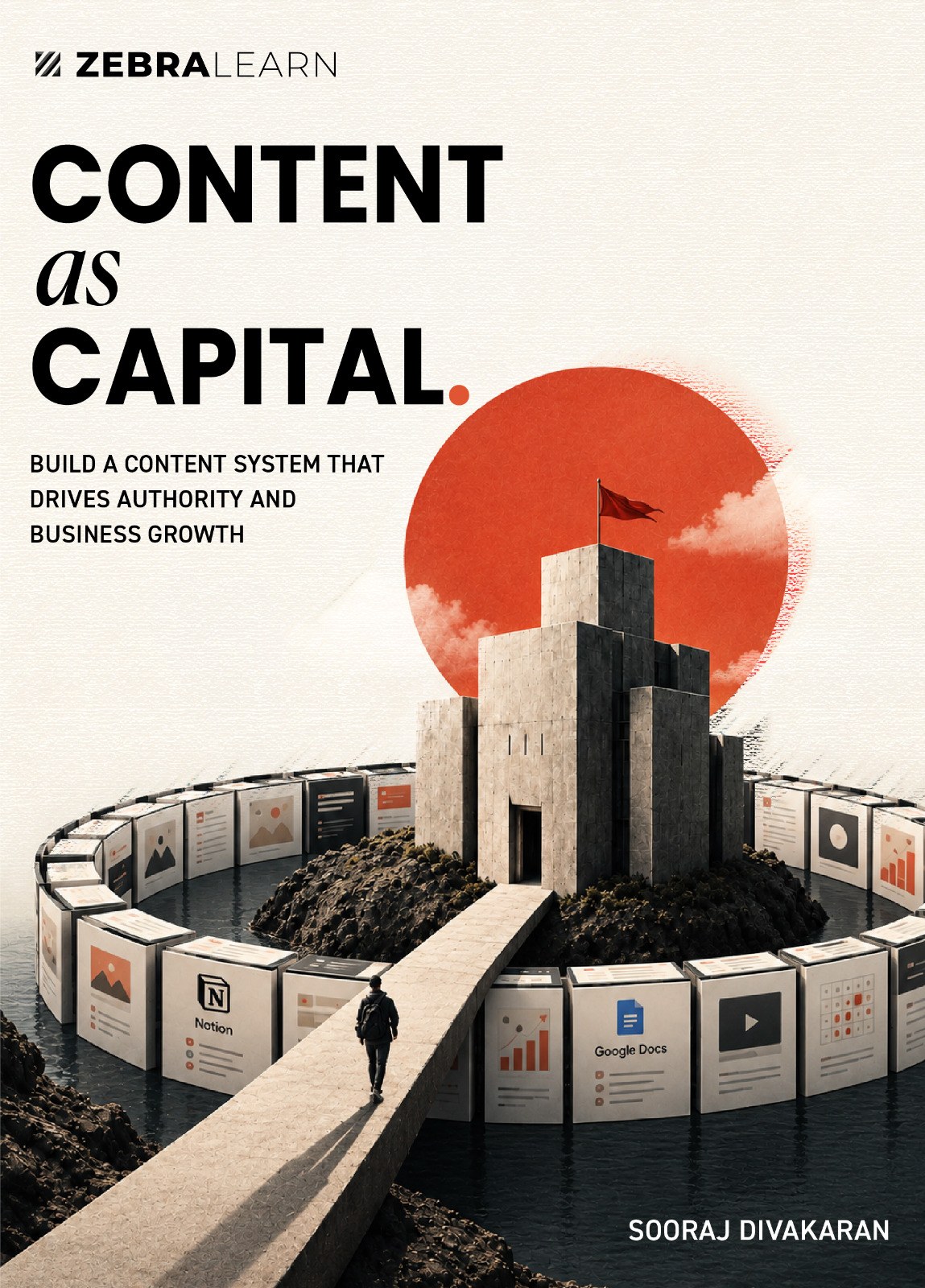
Content as Capital shows founders how to build a content system that drives authority and business growth, so every piece you publish adds to something you own.
By Sooraj Divakaran. Nearly two decades of content-first marketing across Lenovo, TCS, Infosys, Logitech and Firstsource.
Most founders never learned marketing systematically. The books and courses out there assume you already speak the language. So content turns into a chore that sits at the bottom of a very long list. Does any of this sound familiar?
You have shown up on LinkedIn for months. You get likes from friends and silence from buyers. There is activity but no pipeline.
Every lead is paid for. Pause the budget and the phone goes quiet. A year of spending leaves you with nothing you own.
The voice lives in your head. You cannot hand it over without it going flat, so content waits until you are free. You are never free.
Your team reports views and followers. Your investors ask about revenue. Nobody in the room can connect the two.
Most companies record content as a marketing expense. This book asks you to treat it as an asset: something you build, compound and defend. Here is what that looks like side by side.
| Content as an expense | Content as capital | |
|---|---|---|
| When you stop paying | The results stop | What you built keeps working |
| At the end of the year | A pile of old reports | A library, an audience and a reputation |
| Against competitors | They can outbid you | They cannot copy your story |
| Who it depends on | Whoever has time this week | A system your team can run |
| How you judge it | Clicks and impressions | Three metrics and one ROI formula |
India has more founders competing for attention than ever. Paid attention costs more. Buyers trust insight over adverts. And very few teams are getting content right, which is exactly the opening.
DPIIT-recognised startups in India as of 31 March 2026.DPIIT via Inc42. Answered in Chapter 1
startups recognised in FY26 alone, a record year and 51.6% more than FY25.DPIIT via Inc42. Answered in Chapter 2
projected total advertising spend in India in 2026.Pitch Madison Advertising Report 2026. Answered in Chapter 10
of that spend is projected to be digital in 2026, up from 60% in 2025.Pitch Madison Advertising Report 2026. Answered in Chapter 9
rise in customer acquisition costs over five years, the figure most industry studies converge on.SimplicityDX and ProfitWell, via Genesys Growth. Answered in Chapter 10
the leads at 62% lower cost: the long-cited benchmark for content against traditional marketing.Demand Metric. Answered in Chapter 10
is the average age of a page in Google's top 10, which is why good content compounds.Ahrefs ranking study. Answered in Chapter 12
of B2B decision-makers find thought leadership more trustworthy than a company's other marketing materials.Edelman-LinkedIn 2024, 3,484 respondents. Answered in Chapter 5
of B2B decision-makers and C-suite leaders are willing to pay a premium to organisations with valuable thought leadership.Edelman-LinkedIn 2024. Answered in Chapter 5
of B2B decision-makers say brand recognition matters less when thought leadership is strong.Edelman-LinkedIn 2025. Answered in Chapter 1
of B2B marketers say they have a content strategy.CMI and MarketingProfs, Insights for 2026. Answered in Chapter 8
rate their content marketing as highly effective.CMI and MarketingProfs, Insights for 2026. Answered in Chapter 11
A strategy on paper is common. A system that pays back is rare. That gap is what this book closes.
Nine stages, in the order you will use them. Each one rests on the one before it.
The Content-Led Brand Framework, the four types of content-led brands and the three pillars of your content core: founder story, educational content and customer stories.
The four stages of founder evolution, the control paradox and how to turn a personal voice into a business asset.
The BUILD Framework for forming a POV, how T-Mobile broke an entire industry with one and what to do if you have not launched yet.
How Slack found the right moment, two ways to identify moments of need and a 4-week plan for deciding what to create and what to skip.
How to find narrative gaps, test narratives, write your narrative positioning statement and build a content ecosystem around it.
The four dimensions of fit, how to spot it when you have it and how all four came together at Intercom.
The Tiered Platform Strategy, the Hub-and-Spoke Model, the three channels where buyers actually discover solutions and a four-week launch framework.
The three questions that matter, the three metrics that drive decisions, the Content ROI Formula and what good ROI looks like at each stage.
The Fortress Framework, four types of content moats, content loops and the six ways to win at content.
Start building an audience before you have a product to sell.
Grow without an ad budget by making your knowledge do the selling.
Hand content over to a team without losing your voice.
Earn trust through long sales cycles and large buying groups.
Walk in with a system your founder can understand and back.
Turn your expertise into inbound work and a clear position.
14 chapters, from your first principle to your last line of defence.

Sooraj Divakaran has spent the better part of two decades on one question: how does content stop being a marketing line item and start being a business asset? He has built content-first thinking into brands, product launches and demand generation at scale across Lenovo, TCS, Infosys, Logitech and Firstsource.
This book grew out of a set of free workshops he started running for founders. In later pro bono consulting with some of them, he kept seeing the same gap again and again: most founders had never been taught marketing systematically and the resources available all assumed they already spoke its language.
He continues to lead marketing strategy full-time. He writes and speaks on content-led growth.
"In my experience, brands often tackle the question of content last. Those who do not become case studies in books like this one. This book puts content back where it belongs, at the beginning. It is clear, it is practical and it says early what otherwise would be realized much later."Prashant DeorahFounder & CEO, Puretech Digital
"A practical, solutions-oriented guide for founders looking to build trust and strengthen their brand. With actionable ideas and useful frameworks, it is a valuable reference for building credibility and sustainable growth."Sanjay BarrettoGlobal Marketing Leader and Former Global Head of Marketing, B2B and Corporates, English and Exams
"A marketing book that finally speaks to founders instead of marketers. Specific, well-argued and built on real companies rather than theory. Content as Capital doesn't treat content as a checklist. It walks founders through specific, repeatable systems, from turning a single sales call into multiple pieces of content, to building a defensible content moat, grounded in how real companies actually did it."Dr A. Anand KurianSenior Faculty in Marketing, Director, MSc International Business and Strategy, Director, MSc Business and Management, University of Exeter Business School
Both formats carry the full book. Pick the one you will actually read.
No. This book was written for founders who were never taught marketing. It explains each idea in plain language and then gives you a framework to apply it.
No. Chapter 1 opens with the brand without a budget and Chapter 3 shows you how to stop making content creation harder than it needs to be. The system starts with you and grows with your team.
Good timing. Chapter 5 has a section on exactly this, because a point of view can start working before your product does.
Both. The book draws on companies as different as Canva, Slack, Intercom, T-Mobile and Away. Chapter 9 covers platform selection by brand type and Chapter 12 covers industry-specific moat strategies.
Content compounds, so it rewards patience. You can start right away with the 4-week plan in Chapter 6, the four-week discovery framework in Chapter 10 and the 30-day plan in Chapter 12.
[Delivery timeline to be confirmed]
The next best time is your next post. Build something you own.