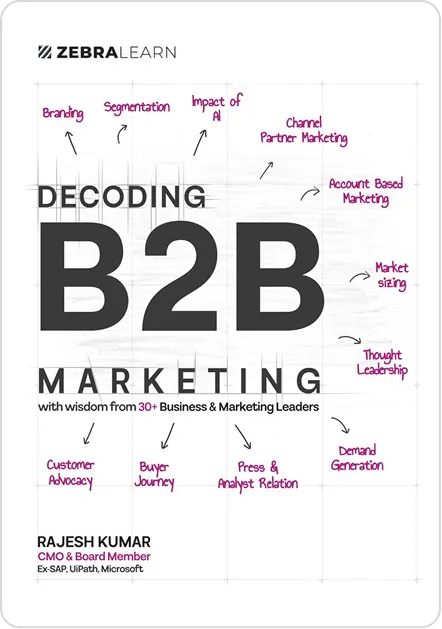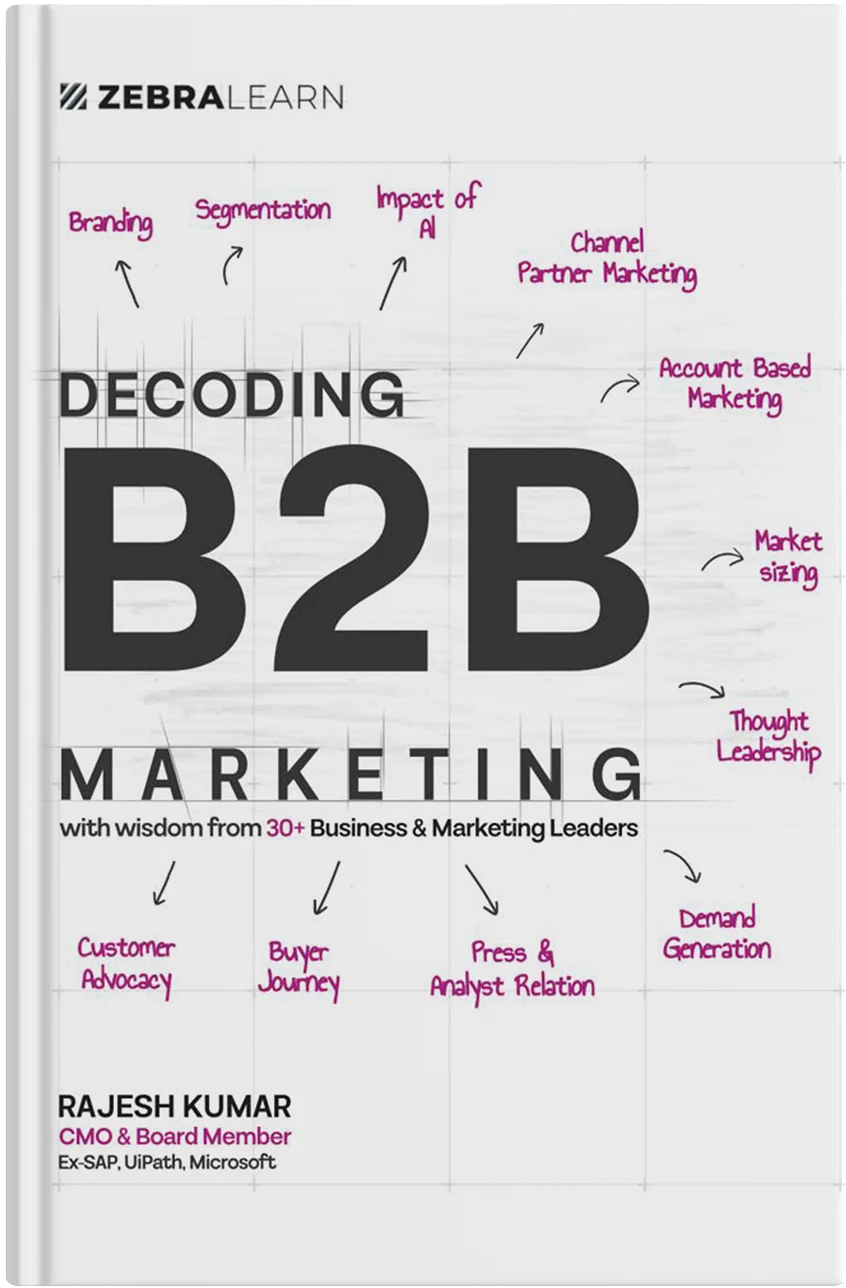


Decoding B2B Marketing

TRUST INDICATORS
500+ Pages
14 Complete
Real Case Studies
Why Most B2B Marketers Fail to Drive Pipeline
87%
Gartner
2.9%
Industry Benchmark 2025
97%
ITSMA Research
$200
2025 B2B Benchmarks
71%
208%
Forrester Research
Here's Why B2B Marketing Remains Broken

The Only Book That Decodes B2B Marketing End-to-End
.webp)
What Makes This Different
Who Will Transform Their B2B Career With This Book?
Account Based Marketing Mastery
What Makes This Different

.webp)
.webp)
.webp)
.webp)
.webp)
By the Numbers:
97%
71%
40%
traditional approaches
$1.83B
(12% annual growth)
The Complete B2B Marketing Curriculum
1.2 Historical Perspective on B2B Trade
1.3 Differentiating B2B from B2C
1.4 Various Types of B2B Markets
1.5 Evolution of B2B Marketing Tactics and Paradigm Shift with the Rise of Digital
1.6 My Story (Author’s Note)
2.2 Market Information and Trends Analysis
2.3 Industry Structure Attractiveness
2.4 Segmenting the Market
2.5 Sizing the Market
2.6 Market Entry Prioritisation
3.2 Buying by Organisational Life Cycle Stage
3.3 Stages in the B2B Buying Process
3.4 What Makes Them Buy?
3.5 Who Is the Buyer in B2B?
3.6 Buyer Group or Decision-Making Unit
3.7 Gathering Customer Intelligence
3.8 Mapping the Buyer Personas
3.9 How to Build a Buyer Persona?
3.10 How Does the Persona Dictate the Marketing Approach?
3.11 Assimilating Customer Understanding for Effective Marketing
4.2 B2B Product Lifecycle Management
4.3 Developing Go-To-Market
4.4 Category Creation
4.5 Product-Led Growth (PLG)
5.2 Understanding Demand and Price Elasticity
5.3 What Is TCO?
5.4 Factors in Pricing Decision
5.5 Setting Pricing Objective
5.6 B2B Pricing Strategies – Selecting the Right Fit
5.7 Industry-Based Use Cases
5.8 Software Pricing Models
5.9 Industrial Plant and Machinery Pricing Models
5.10 Pricing Models for Raw Materials / Inputs in Manufacturing
5.11 Rolling Out a Pricing Strategy
5.12 Adapting Pricing in a VUCA World
6.2 Why B2B Businesses Must Think About Branding Early On
6.3 Defining Your Brand
6.4 Developing the Narrative
6.5 Visions Are Visual – Designing a Distinctive Identity
6.6 Evolution of Brand Identity Over Time
6.7 Branding in Action: Making Your B2B Brand Sing Across Touchpoints
7.2 Distinction in Brand and Demand Communication
7.3 B2B Customer Communication Channels
7.4 Bringing It All Together
8.2 Developing a Public Relations Programme
8.3 Analyst Relations Management
8.4 How to Manage Analyst Relations
8.5 Measure and Evaluate
8.6 Internal Communication: Mobilising the Organisation
9.2 How Do You Approach Demand Planning?
9.3 Where Does Your Offering Stack Up in the Hierarchy of Needs?
9.4 What Organisation Size Are You Planning Demand Generation For?
9.5 New Customer Acquisition vs Existing Customer
9.6 Tactics by Audience Size
9.7 Outbound vs Inbound
9.8 Lead Funnel Management
9.9 Lead Qualification Criteria
9.10 The Evolution of the Buyer Journey – Forrester Sirius Decisions Demand Waterfall
9.11 Building a Digital and Tele-Demand Centre
9.12 Measuring Your Demand Generation Efforts: Proving Value Relations Programme
10.2 How ABM Differs from Demand Generation
10.3 Role of Sales and Marketing Alignment
10.4 Various Types of ABM
10.5 The ABM Process: Where to Begin the Journey
10.6 Resourcing for ABM
10.7 Technology and Tools for ABM
10.8 Case Studies
11.2 Different Types of Partners
11.3 Channel Partner Marketing
11.4 Prioritising Channel Partners
11.5 To, Through, and With-Partner Marketing
11.6 Delivering a Partner Marketing Program
11.7 Who Pays for Channel Marketing?
11.8 Tracking Success
12.2 Creating a Customer Advocacy Programme
12.3 Developing Advocacy Assets
12.4 Measuring Advocacy Impact
13.2 Building an Annual Operating Plan
13.3 Organisation and Processes Design
13.4 Financial Resource Management
13.5 Performance Management
13.6 Tracking and Reviewing Progress
13.7 Trend Towards Revenue Operations
14.2 Data as a Fundamental Building Block
14.3 Developing and Implementing MarTech Strategy
14.4 Solution and Vendor Selection
14.5 Deploying and Running the Stack
Real-World B2B Marketing Skills You'll Master
Everything You Get Inside

Decoding B2b Marketing
Other B2B Marketing Resources

The B2B Marketing Reality: What the Data Shows
97%
Source: ITSMA 2025
208%
71%
Source: State of ABM Report 2025
40%
Source: Multiple B2B Studies 2025
$200
2.9%
Source: Ruler Analytics 2025
87%
Source: Gartner Research
11-50%
Source: ABM Industry Analysis
$1.83B
The B2B Marketing Gap Widens Every Day
Get Decoding B2B Marketing Now
Frequently Asked Questions
This book is specifically designed for B2B marketing—long sales cycles, multiple stakeholders, high-value deals, and complex buying processes. While some principles overlap, B2B requires fundamentally different strategies than B2C. If you're planning to transition into B2B marketing or your company serves both markets, the frameworks here will be valuable. But if you're purely focused on B2C/e-commerce, you might find other resources more relevant.
Not at all. While the book builds foundation, it quickly moves into advanced B2B strategy—ABM orchestration, revenue attribution, pricing psychology, channel partnerships, and marketing operations. Even experienced marketers report learning new frameworks, especially around sales-marketing alignment and full-funnel attribution. If you're currently running B2B campaigns but struggling to prove pipeline impact or scale programs, this book will elevate your strategic thinking.
Extremely practical. Every chapter includes ready-to-use frameworks, templates, and worksheets. You'll get ABM account scorecards, buyer persona templates, demand waterfall trackers, campaign planning frameworks, budget models, tech stack assessments, and more. The book is designed for implementation, not just theory. Many readers apply frameworks to their business while reading.
No. While digital channels are covered extensively, the book addresses the complete B2B marketing ecosystem—including traditional channels, events, PR, partner programs, and corporate communications. The frameworks apply across industries: software/SaaS, manufacturing, industrial products, professional services, infrastructure, and more. The principles work whether you're selling $10K software subscriptions or $10M industrial systems.
Absolutely. The book includes specific guidance for different organizational stages and budget levels. You'll learn how to prioritize programs based on resources, scale marketing systems as you grow, and make strategic decisions about build vs. buy, in-house vs. agency, and where to invest first. Many frameworks are designed specifically for resource-constrained environments.
Yes—in multiple ways. You'll learn to think strategically about marketing (highly valued skill), speak the language of revenue (critical for leadership roles), understand complete B2B systems (rare capability), and apply frameworks that prove business impact. Readers report using these concepts in interviews, strategy presentations, team planning, and conversations with executives. It positions you as a strategic thinker, not just a tactical executor.
Most B2B marketing books are written for Western markets with different dynamics—higher budgets, mature sales processes, established categories, and sophisticated buyers. This book addresses those realities while including Indian market context: building categories in emerging markets, working with channel partners, navigating price-sensitive buyers, and scaling with limited resources. You get global best practices adapted for local implementation.
No—it's perfect for founders. You'll understand what effective B2B marketing actually looks like, how to evaluate marketing talent, what questions to ask agencies, how to set realistic budgets, and which metrics actually matter. Most importantly, you'll stop outsourcing strategy blindly and start building marketing capability that scales with your business. Think of it as your B2B marketing education compressed into one comprehensive resource.
Yes—throughout every chapter. You'll see real examples from software companies, industrial manufacturers, professional services, technology platforms, and more. Case studies show how companies implement ABM programs, structure pricing, build channel partnerships, create advocacy programs, and scale marketing operations. Examples range from startups to established enterprises.
The frameworks in this book are based on fundamental B2B principles that don't change—buyer psychology, decision-making processes, value communication, relationship building. While tactics and technologies evolve, the strategic foundation remains constant. The book teaches you how to think about B2B marketing, not just what to do, so you can adapt as markets change.
How Different B2B Professionals Use This Book
LEAD
LEADER
Stop Guessing. Start Growing.

Digital Access