The complete step-by-step manual that answers every question a first-time founder has. From your first raw idea to a business that actually makes money.
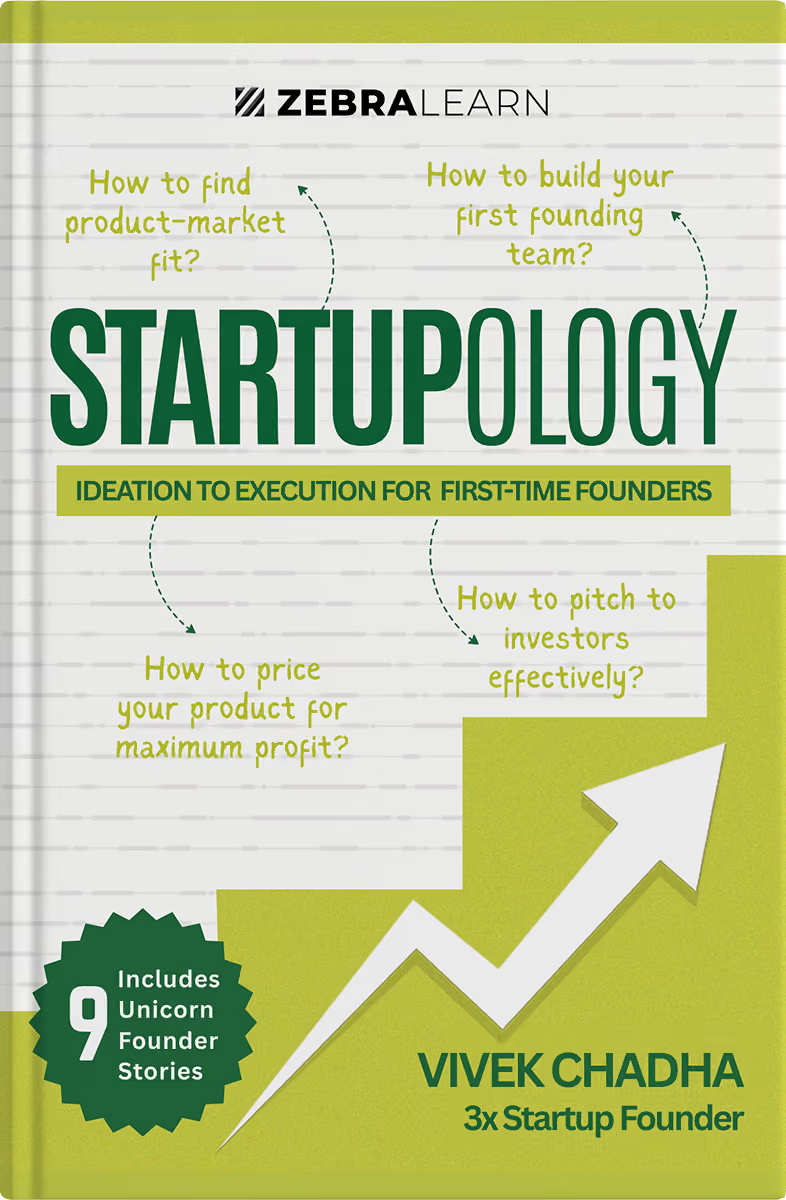
Starting Up Should Not Feel Like Guesswork
You have the drive. What you do not have is a map. So the same eight questions keep you stuck.
Is my idea solving a real problem or am I just in love with it?
Will my target customers actually pay for this?
Should I bootstrap or raise money - and when is the right moment?
Do I need a co-founder or should I go solo?
How do I hire a team when I cannot match big salaries?
What if a competitor has more money and more experience?
How do I market with no budget and zero brand recognition?
What if I spend months building something nobody wants?
You should not have to learn all of this through expensive mistakes.
A Complete System. Not Another Pep Talk.
Most startup books sell motivation. Startupology hands you the frameworks, templates and decisions you need at every stage. The same ones used by founders who actually made it. Open the page for your problem. Apply the framework. Move forward.
Every Framework You Need, In One Place
No theory dumps. Each chapter hands you a tool you can open and use the same day.
Business Model Canvas
See your whole venture on one page.
pg. 220Value Proposition Canvas
Validate the idea before you build it.
pg. 43Blue Ocean Strategy
Build new market space instead of fighting for scraps.
pg. 190PDCA Improvement Cycle
Iterate your product without guessing.
pg. 334Three-Statement Financial Model
Build numbers investors trust.
pg. 284ESOP and Compensation Design
Attract talent you cannot yet outbid.
pg. 98Distribution Playbooks
For both product and service businesses.
pg. 166The ALIVE Framework
Built to beat the top reasons startups fail.
pg. 340This book compressed years of hard-won lessons into 300 pages. The frameworks alone are worth many times the price.
Built To Be Used, Not Just Read
Complete journey, idea to scale
Frameworks you apply, not theory you memorize
Real case studies with real numbers
Templates and worksheets included
Decision-making methodologies
A knowledge system that compounds
One-time price, lifetime access
Written from the founder’s seat
The Odds Are Brutal. A System Tilts Them.
What the research says about first-time founders - and what Startupology does about it.
of startups fail over their lifetime. Most of it traces back to year-one decisions.
fail for one reason: no real market need. Module 6 targets this first.
run out of cash before they ever find traction.
of all shutdowns come from those two causes combined.
fail because the founding team was wrong. Module 3 fixes this early.
is the success rate for first-time founders. A blueprint moves the number.
new businesses close inside their first year.
in venture funding flowed in 2025. The capital exists for founders who can prove traction.
Sources: CB Insights · US Bureau of Labor Statistics · Startup Genome · Embroker · DemandSage
11 Modules. One Clear Path From Idea to Scale.
Tap any module to see exactly what is inside.
42% of startups fail because the market never needed the product.
Stop Building Things Nobody Wants
Your idea means nothing until a customer pays for it. Module 6 gives you the validation system that proves product-market fit before you burn months building the wrong thing.
“We were three weeks from launching a product nobody wanted. This validation framework saved us months of wasted build time and pointed us to the offer that finally worked.”
29% of startups die with an empty bank account.
Raise Money Without Losing Your Company
Most first-time founders accept terms that quietly cripple them. The funding chapter gives you the pitch, the model and the negotiation moves to fund the business on your terms.
“We pitched 30 investors and kept hearing no. The funding chapter rebuilt our pitch and financial model from scratch. We closed our round in five weeks.”
23% of startups fail because the founding team was wrong.
Build a Team That Stays
Co-founder fallouts kill more companies than competition does. Set the foundations early so they never turn into company-ending fights.
“We attracted a CTO who had turned down offers from three funded startups. One year later we are a team of twelve with zero co-founder conflict.”
Decode How Category Leaders Actually Scaled
Four breakout companies, broken down into the exact growth engines you can borrow.
OYO
How one property scaled to thousands. The distribution playbook behind hyper-growth.
Zomato
The path from scrappy startup to public market plus the bets that got it there.
CRED
How a brand won a high-value audience by making loyalty feel premium.
Paytm
From a recharge app to a full ecosystem plus the partnership model that fueled it.
Who This Book Is For
This is for you if
This is not for you if
Who Gets the Most From Startupology
If you sit in any of these seats, this manual was written for your exact next move.
First-Time Founder
Gives you a start-to-finish path so you stop guessing. Every stage comes with a framework you can act on.
Solo Founder and Indie Hacker
Shows how to validate, build and sell without a big team. Capital-light tactics for one-person ventures.
Startup Co-Founder
Sets equity, ESOPs and culture early. Partnership cracks never grow into company-ending disputes.
Side-Hustler Going Full-Time
Helps you test demand and model the numbers before you quit a steady paycheck.
Product Manager Turning Founder
Translates product skill into go-to-market, fundraising and business-model decisions.
MBA Graduate and Student
Bridges classroom theory and real execution with frameworks you apply on day one.
Small Business Owner Scaling Up
Brings distribution, KPIs and business-model innovation to a venture that has plateaued.
Agency and Service Owner
Productizes services, fixes pricing and builds a repeatable engine for steadier revenue.
Founders Who Stopped Guessing
Real readers across the US, UK and UAE on what changed after Startupology.
I had six months of motion and zero traction. The validation framework forced me to test demand before building. We killed two features nobody wanted and shipped the one that got us our first 40 paying customers.
Most startup books are stories. This one is a system. The Value Proposition Canvas alone saved us from a launch that would have burned our whole first budget.
We pitched 30 investors and kept hearing no. The funding chapter rebuilt our entire pitch and financial model. We closed our round in five weeks.
The equity and ESOP frameworks helped us set up our founding team properly. A year in, we are twelve people with zero co-founder drama. That alone was worth it.
I have read a shelf of startup books. None gave me templates I could open and use the same day. The Business Model Canvas walkthrough is the clearest I have seen.
I came from services and had no idea how to productize. The distribution and business-model sections gave me a repeatable engine. Revenue is finally predictable.
Everything You Get In One Manual
pages of step-by-step strategy you can act on
downloadable templates and worksheets
case studies with real metrics and steps
One Investment. A Lifetime of Frameworks.
Both formats include the digital templates and worksheets.
Before You Decide
Yes. While some examples are tech, the frameworks apply to every kind of business. There are dedicated sections for service businesses, D2C brands and traditional companies.
Most startup books focus on stories and motivation. This one gives you the exact steps, templates and decision tools you need at each phase of the journey.
Not at all. Many readers use it to diagnose where their business is stuck then apply the right framework to move forward. The modular layout lets you jump straight to your challenge.
No. It is written for first-time founders with little to no business background. Complex ideas are broken into simple steps you can act on.
Some apply the same day, such as the decision-making methods. Others unfold over weeks. Most readers see tangible progress inside the first 30 days.
Yes. There is a full section on bootstrapping with capital-efficient growth tactics, customer-funded models and ways to stretch every resource.
The hardcover ships to the US, the UK and the UAE. The digital copy is available instantly anywhere with a one-time payment.
Your Next 12 Months Do Not Have To Be Trial and Error
The difference between a startup that works and one that stalls is rarely luck. It is having a proven roadmap. Start with the manual.